How to Conduct a Trademark Search in India?
Learn how to conduct a trademark search in India using the new AI-powered IP India tool. Step-by-step guide with word, phonetic, and Vienna searches explained.
Aaroh Law
10/9/20254 min read
The Smart Business Owner's Guide to Trademark Search in India
Every year, thousands of Indian entrepreneurs learn an expensive lesson by launching a brand without conducting proper trademark research can destroy years of hard work in a single legal notice. In 2025, with India's trademark applications reaching record highs and new AI-powered search tools transforming the landscape, understanding how to navigate trademark searches has become both more crucial and more accessible than ever.
Why Businesses Can't Afford to Skip Trademark Search in India?
India processes over half a million trademark applications annually, creating an increasingly crowded registration landscape. What seemed available yesterday might be claimed today, making real-time search capabilities essential.
With the explosion of e-commerce and digital services, trademark conflicts now span across traditional industry boundaries. A food delivery app might conflict with restaurant names, cooking equipment brands, or even food blog trademarks.
Many entrepreneurs mistakenly believe that company name registration or domain availability indicates trademark clearance. In reality, these provide no trademark protection, leaving businesses vulnerable to infringement claims.
Why a Trademark Search Matters?
Before filing your trademark application in India, conducting a proper, comprehensive search is essential. The Official IP Trademark Search in India portal can be accessed here, IP India TM Search
A trademark search helps you:
Avoid refusal due to similarity with any existing trademark at the Trade Marks Registry.
Identify existing similar marks that may cause confusion.
Save time, money, and brand reputation by reducing the risk of disputes.
Simply put, Imagine building your dream café called “Bean & Brew”, only to learn months later that another café named “Beanz n Brewz” already owns the trademark. A quick search could have saved you that trouble
What are the Types of Trademark Searches in India?
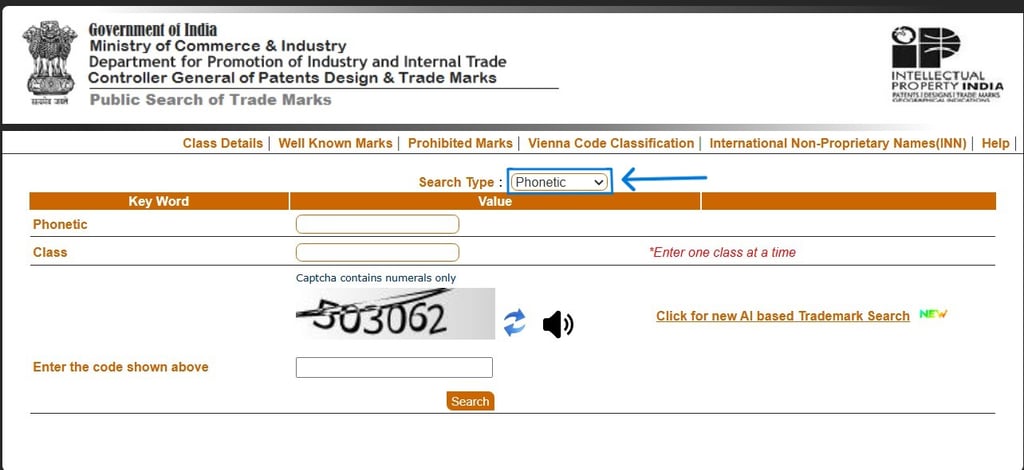
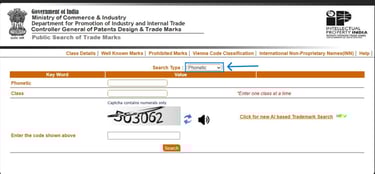
2. Phonetic Search: This captures marks that sound similar, even if they are spelled differently.
Example:
“Kwik” and “Quick” may look different but sound identical. The phonetic search ensures such conflicts are not missed.
You can perform two primary searches on the official Trademark Public Search Portal:
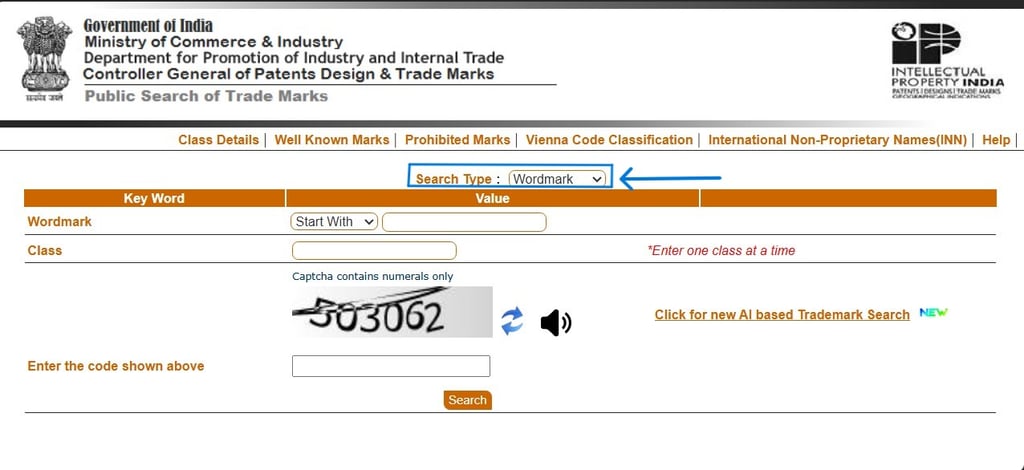
1. Word Mark Search: A wordmark search looks for identical or similar words to your proposed trademark.
Example:
If you search for “GloSki”, the system may display results like “GloSkin,” “Gloskinz,” or “Gloskin Naturals.”
3. Selecting the Correct Class (Mandatory Step): Every product or service you intend to protect must fall under one of 45 classes as per the NICE Classification System.
These classes categorize goods and services so that similar types of products are grouped together. For example:
Class 25 - Clothing, footwear, and headgear
Class 3 - Cosmetics, perfumes, soaps
Class 9 - Software, electronics, scientific instruments
When conducting your Wordmark or Phonetic search, you must select the relevant class before clicking “Search.” This ensures that the results shown are specific to your business category.
Selection of the wrong class can completely distort your results. For instance, if you search “GloSkin” under Class 25 (clothing) instead of Class 3 (cosmetics), you may miss a conflicting trademark in the correct category.
Professional Tip: If your brand deals in multiple products or services spanning more than one class (e.g., cosmetics + pharmaceutical + nutraceutical), conduct separate searches for each class. Each class represents a separate trademark filing in India.
Common Mistakes to Avoid:
Many businesses lose time and money because they skip or misunderstand this step.
Searching in the Wrong Class:
A brand selling perfumes (Class 3) and vaporizer for perfume (Class 21) might mistakenly search under Class 3 only.Ignoring Phonetic Variations:
“Kwik,” “Quick,” and “Kwickk” might all be considered similar.Overlooking Visual or Device Marks:
If your logo includes a design element (like a butterfly or star), check for similar device marks under the Vienna Code Classification.Not Checking Status of Marks:
Some marks are abandoned or refused, but still appear in search results. Verify their status before ruling them out.Relying Only on Basic Keyword Search:
Trademark search is not about finding an exact match, it’s about finding confusingly similar marks. Professional analysis helps in this interpretation.
Want to avoid these pitfalls? Explore our Ultimate Guide to Trademark Registration in India (2025 Edition
AI-Powered Advanced Search:
The Indian Trademark Office has introduced an AI-based search system to make searches more accurate, accessible, and intelligent. Access it here, AI Trademark Search – IP India
What the AI Tool Can Do?
Phonetic Similarity: Detects marks that “sound like” yours, even if the spelling is very different.
Conflict Prediction: The AI highlights trademarks that could trigger an objection from the Registry.
Image Filtering: Upload your logo to find visually similar marks (powered by image recognition).
Class Filtering: Narrow down by your product or service category.
Real-Time Database: The system updates live with every new filing.
Why it matters: Many founders think changing one letter makes their mark unique. The AI tool proves that conceptual or phonetic similarity can still cause refusal.
Practical Example:
Let’s assume, you want to trademark “ZENTRA” for manufacturing of electronics (in Class 9).
You search under:
Wordmark → “ZENTRA”
Phonetic → “CENTRA,” “SENTRA,” “ZENTRO,” etc.
The results may show an existing mark “SENTRA ELECTRONICS.”
Even though the spelling differs, the sound is almost identical, so an objection may arise.
A professional analysis helps you interpret whether to modify the name, change the class, or proceed strategically. To know more, check our Trade Marks Practice Circles.
A trademark search is the foundation of every strong brand identity. It ensures your brand is legally safe, distinctive, and future-ready.
With the new AI-powered IP India tool, conducting a trademark search is now faster and smarter. But remember, searching is just half the battle. Interpreting the results correctly is where expertise matters.
Taking time to perform a comprehensive search today can save you months (or even years) of branding disputes tomorrow.
Any brand in mind for which you need a Search Report, send us brand and corresponding details here and we will get back to you with an actionable Trademark Search Report.
Summarily,
© 2025 | Aaroh Law All Rights Reserved
Practice Circles
Contact Us


